
Audit log
Everything that changes something is recorded in the hub's PostgreSQL database, with the person who did it. Open Activity to see it. You need the audit.view permission.
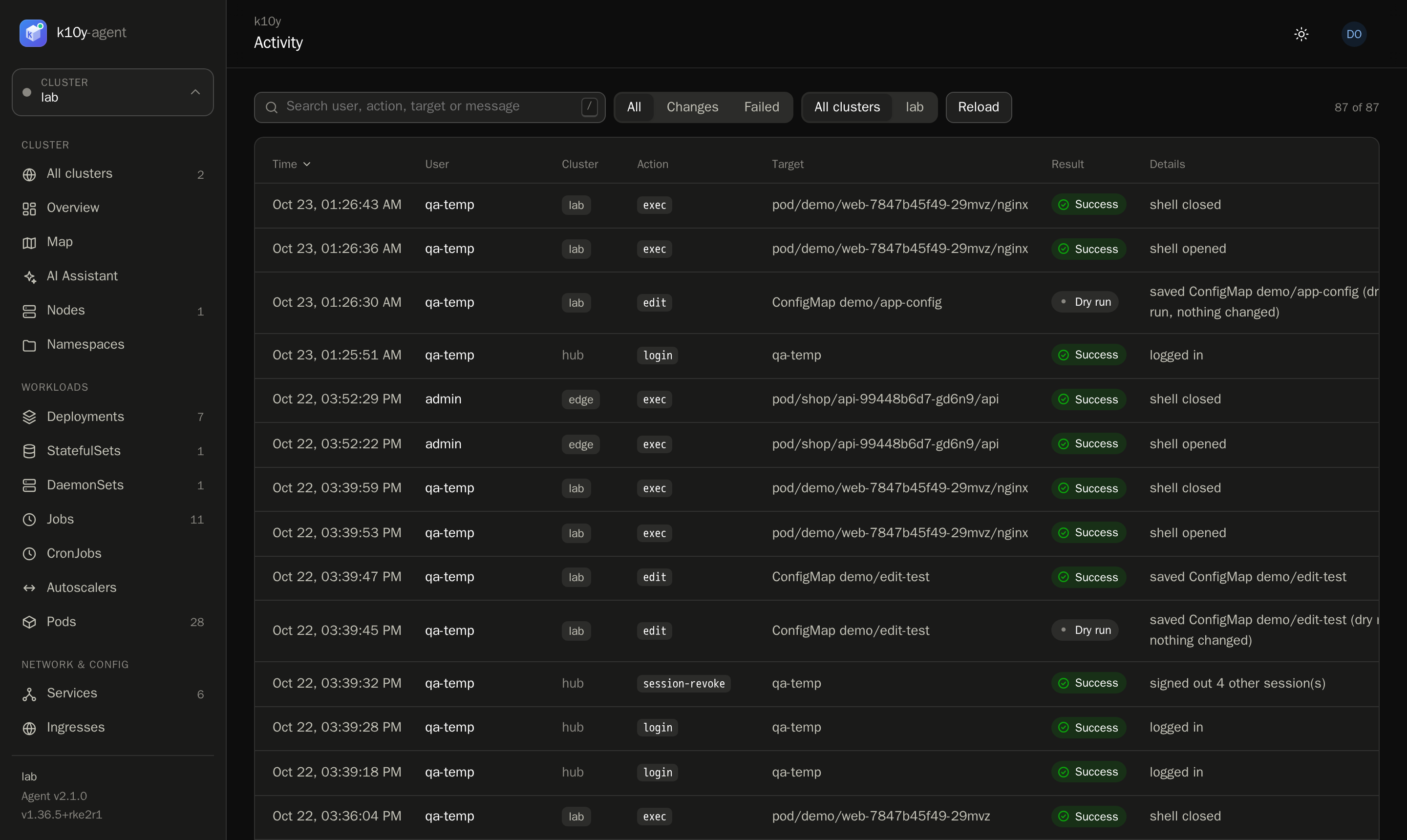
What's recorded
| Kind | Examples |
|---|---|
| Actions | scale, restart, set image, rollback, delete, cordon, drain, apply, CronJob run/suspend/resume |
| Edits | edit with the object's kind, namespace and name |
| Shells | exec when a shell opens and closes, with its duration |
| Sign-in | successful and failed logins, password changes, signed-out sessions |
| Administration | users, roles, clusters, AI settings, alert channels and rules |
| AI | every investigation, with the model and the number of issues found |
Each entry has the time, user, cluster, action, target, parameters, result (success, dry run or failed), a message and the client IP. Dry runs, refused actions and attempts against unreachable clusters are recorded too.
Read-only views (opening pages, reading logs) are not recorded.
Filters
Search by user, action, target or message. Show All, only Changes, or only Failed entries, for all clusters or the current one.
Download
Download on the Activity page saves the last 90 days you can see (all clusters, or the current one) as CSV. The API also gives JSON: GET /api/hub/audit/export?format=json&days=30.
Export to a SIEM or log system
System settings → Activity log export (needs settings.manage) copies every entry as it's written, including shells and port-forwards, to any of:
- Webhook: JSON batches (
{"entries": [...]}) POSTed every few seconds, for Splunk HEC, Elastic, Datadog or your own service. With a signing secret,X-K10y-Signature: sha256=<hex>is the HMAC-SHA256 of the body. - Syslog: RFC 5424 lines with the entry as JSON, over UDP, TCP or TLS (rsyslog, syslog-ng, most SIEMs).
- Files: one JSON line per entry in
/data/audit/audit-YYYY-MM-DD.jsonlinside the hub (in./data/hub/auditwith Docker Compose), with old files removed after the days you choose.
Save & send test sends one test entry to every destination you turned on and shows any error. Each entry has time, user, cluster, action, target, ok, dry_run, message, params, client_ip and source: "k10y".
Retention
Keep in k10y sets how long entries stay in the database: forever (the default), 90 or 180 days, 1 or 2 years. Older entries are removed once an hour; exported copies aren't affected. Entries are included in the backups. Each agent also keeps a small local log of its own actions.