
Users, roles and permissions
Admins with the users.manage permission manage people under Administration → Users and Administration → Roles.
How access works
- A role is a named set of permissions. You can create as many as you like.
- A user gets one or more role assignments. Each assignment is for everything, for one cluster, or for one HAProxy instance.
- On one cluster, only the role's cluster permissions count there. On one HAProxy, only its HAProxy permissions count there.
- A user only sees clusters where they have at least
cluster.view, and HAProxy instances where they have at leasthaproxy.view. - Hub permissions (managing users, clusters, settings and alerts) only count when the role is assigned on everything.
So "Operator on staging, Viewer on production" is two assignments for one user, and so is "HAProxy operator on lb-edge-1 only".
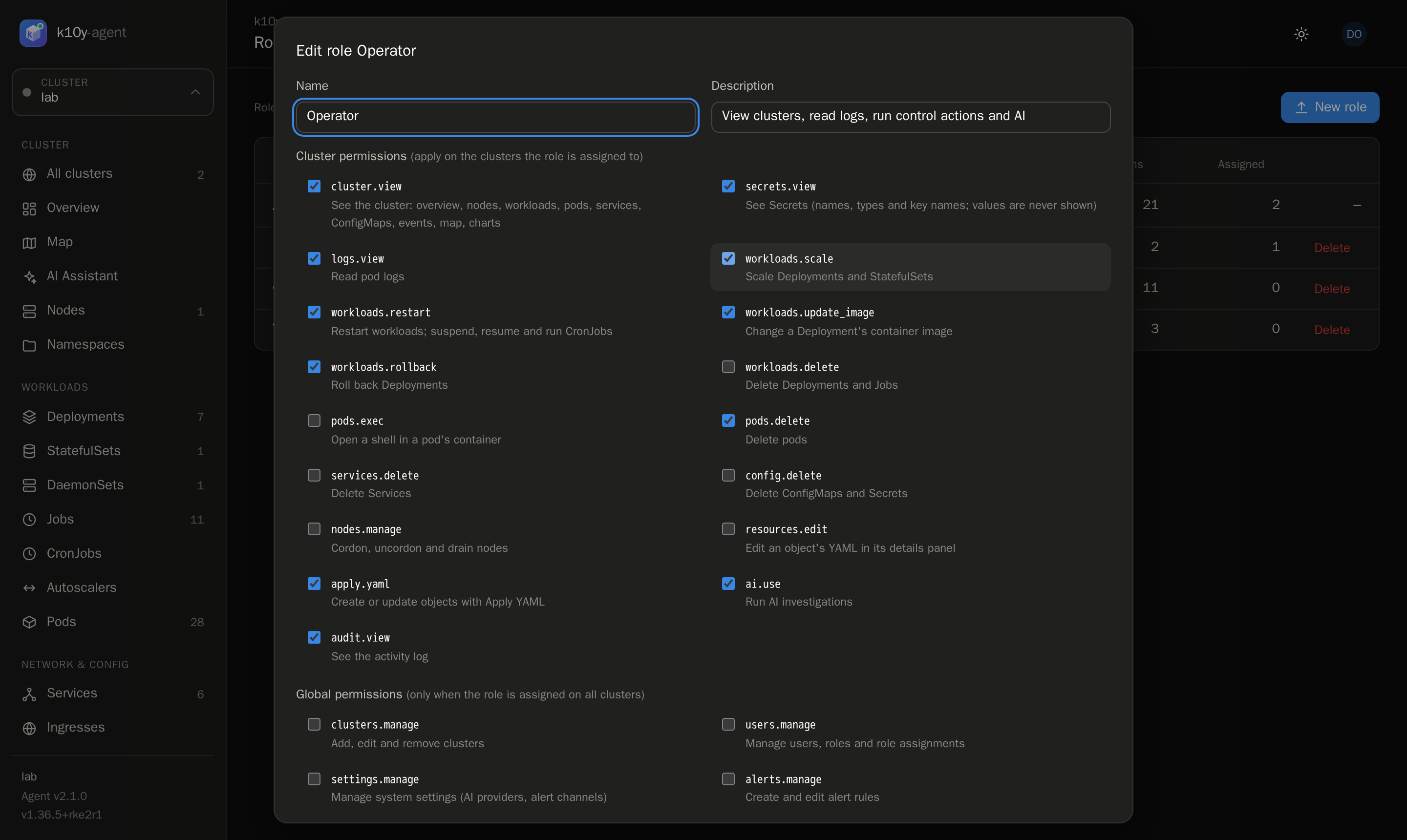
Permissions
Per cluster
| Permission | Allows |
|---|---|
cluster.view | See the cluster: overview, nodes, workloads, pods, services, ConfigMaps, events, map, charts |
secrets.view | See Secrets (names, types and key names; values are never shown) |
logs.view | Read pod logs and live logs |
workloads.scale | Scale Deployments and StatefulSets |
workloads.restart | Restart workloads; suspend, resume and run CronJobs |
workloads.update_image | Change a Deployment's container image |
workloads.rollback | Roll back Deployments and Helm releases |
workloads.delete | Delete Deployments and Jobs |
pods.exec | Open a shell in a pod's container |
services.proxy | Open a Service's web page (HTTP port) in the browser through the hub |
pods.portforward | Forward a pod's or Service's TCP port to your computer (k10y port-forward) |
pods.delete | Delete pods |
services.delete | Delete Services |
config.delete | Delete ConfigMaps and Secrets |
nodes.manage | Cordon, uncordon and drain nodes |
resources.edit | Edit an object's YAML in its details panel |
apply.yaml | Create or update objects with Apply YAML |
namespaces.protect | Choose the cluster's protected namespaces, where every action, edit and shell is refused |
ai.use | Run AI investigations |
audit.view | See the activity log |
HAProxy (assign on one HAProxy instance, or on everything)
Permissions cover a whole HAProxy instance: all its frontends, backends and servers.
| Permission | Allows |
|---|---|
haproxy.view | See the instance: frontends, backends, servers, live numbers, charts, topology, logs, certificates, stick tables, the IP blocklist and config history (not the raw config) |
haproxy.operate | Run it without changing its config: drain, maintenance and re-enable servers, rolling deploys, block and unblock IPs, let rate-limited clients in again (instant, no reload) |
haproxy.configure | Change its config: frontends, routes, backends, servers, maintenance pages, certificates, Kubernetes sync, copy and group sync, restore old versions; read and edit the raw config (it can contain passwords) |
haproxy.manage | Edit or remove the instance and its Data Plane API login. Adding a new instance needs this on everything |
Notes:
- The first IP block on an instance adds the blocklist to every frontend, which is a config change, so it needs
haproxy.configureonce. After that,haproxy.operateis enough. - Changing several instances of a group at once needs
haproxy.configureon each of them. "Compare configs" only shows the members you can configure.
Hub (assign on everything)
| Permission | Allows |
|---|---|
clusters.manage | Add, edit and remove clusters (their agent URLs and tokens) |
users.manage | Manage users, roles and role assignments |
settings.manage | Manage system settings (AI providers, alert channels) |
alerts.manage | Create and edit alert rules |
Built-in roles
One set of roles per system, plus Admin. Give Kubernetes roles on everything or one cluster, and HAProxy roles on everything or one HAProxy.
| Role | Assign on | Permissions |
|---|---|---|
| Admin | everything | Everything, including users, settings, clusters and HAProxy instances. It can't be edited or deleted. |
| Kubernetes viewer | everything or one cluster | View, logs and activity. |
| Kubernetes operator | everything or one cluster | View, logs, Secrets, scale, restart, update image, roll back, delete pods, edit YAML, apply YAML, AI, activity. Not the shell. |
| Kubernetes admin | everything or one cluster | Every cluster permission, including deletes, the pod shell, draining nodes and choosing protected namespaces. |
| HAProxy viewer | everything or one HAProxy | See frontends, backends, servers, live numbers, logs and history. |
| HAProxy operator | everything or one HAProxy | Viewer, plus drain and maintenance, rolling deploys, blocking IPs and the AI assistant. No config changes. |
| HAProxy admin | everything or one HAProxy | Everything on HAProxy: config changes, the raw config, the connection, and the AI assistant. |
For someone who works on both, give two roles, e.g. Kubernetes operator on staging and HAProxy operator on lb-edge-1. The Roles page shows which system each role applies to. Edit the built-in roles or create your own.
Upgrading from 2.4 or older: the old Operator and Viewer roles are renamed Kubernetes operator and Kubernetes viewer. Their HAProxy permissions move to HAProxy operator and HAProxy viewer, which their users get automatically, so nobody loses access.
Add a user
Users → New user: username, display name, a starting password, and one or more role assignments. Keep Must change password at next login ticked so they choose their own.
Day-to-day
- Reset a password: open the user, type a new password and save. They're signed out everywhere and must change it at the next sign-in.
- Disable an account: Disable on the Users page. They're signed out immediately and can't sign in until enabled again.
- Sign a user out: Sign out signs them out of every device. See Sessions.
- Delete a user: their past actions stay in the audit log under their username.
There must always be at least one active user who can manage users on all clusters. k10y won't let you remove the last one.
Example roles
| Role | Permissions | Assign |
|---|---|---|
| Developer | cluster.view, logs.view | production only |
| Developer (staging) | Operator permissions + pods.exec | staging only |
| On-call | Operator permissions + nodes.manage | all clusters |
| Auditor | cluster.view, audit.view | all clusters |
| HAProxy operator | haproxy.view, haproxy.operate | one HAProxy, e.g. lb-edge-1 |
| Load balancer admin | all four haproxy.* permissions | one HAProxy, or everything to also add new instances |